





Hambi recommends using hotel-grade bedding. These bedding items are made of satin-cotton fabric, with exquisite craftsmanship and a smooth texture. They are entirely made of pure cotton and are perfect for use in upscale hotels and residences. Not only are they luxurious in appearance, but they also offer an ultimate comfort experience, making them an excellent choice for improving sleep quality. Whether used in a hotel or at home, these bedding items will allow you to enjoy a five-star sleep experience!
×
"Polyester vs. Cotton Bed Sheets: Which One Is Better for You?"
2025-10-10
"Polyester vs. Cotton Bed Sheets: Which One Is Better for You?"
In the grand narrative of hotel operations, the choice of bed sheets is of utmost importance. It directly affects the guests' sleep experience, the hotel's operating costs, and the shaping of its brand image. Polyester (polyester) and cotton, as the two dominant materials, have distinct inherent differences that determine their completely different application scenarios. This article will delve into the world of materials, systematically compare their characteristics, and based on this, analyze their adaptability and selection criteria in hotels, providing a solid basis for your decision-making.
1.Chapter One: Comparison of Core Characteristics of Materials
All choices begin with understanding. Polyester and cotton, stemming from different paths of chemical synthesis and natural growth, endow them with their inherent unique characteristics.
Physical and chemical structure
Cotton: A natural cellulose fiber derived from cotton. Its fibers have a hollow, flat ribbon-like structure, forming natural capillaries. This characteristic determines its outstanding moisture absorption and breathability.
Polyester: A synthetic polymer of high molecular weight, mainly derived from petroleum. Its molecular chain structure is dense and robust, which endows it with extremely strong hydrophobicity, wear resistance and wrinkle resistance.
2. Comparative Table of Comprehensive Characteristics
The following table provides a clear and concise illustration of their performance in key dimensions.
Characteristic Dimension:
Cotton bed sheet:
Touch and Comfort: Soft, skin-friendly, simple, and becomes softer with washing
Air permeability and heat management: ★★★★ (Excellent, the hollow structure facilitates air circulation, warm in winter and cool in summer)
Wetness absorption and moisture release: ★★★★ (Strong wetness absorption ability, can quickly absorb sweat and keep dry)
Durability and shape stability: ★★★☆ (High-quality cotton is durable, but prone to wrinkling, shrinking, and yellowing)
Maintenance convenience: ★★★☆☆ (Attention should be paid to washing temperature, prone to wrinkling, requires high-intensity ironing)
Environmental impact: Traditional cultivation consumes water and pesticides; organic cotton is more sustainable
Polyester bed sheets:
Touch and comfort: Smooth, cool, and initially may have a slight "artificial" feel; the high-tech polyester has significantly improved this aspect.
Air permeability and heat management: (Poor, heat tends to accumulate, prone to feeling hot and stuffy)
Wet absorption and moisture discharge property: (Hydrophobic, does not absorb moisture but discharges moisture quickly, feels prone to being damp)
Durability and form stability: (Extremely wear-resistant, resistant to stretching, resistant to wrinkling, with excellent shape retention)
Maintenance ease: (Almost no ironing required. Washes easily and dries quickly. Does not shrink or fade.)
Environmental impact: Dependent on petroleum resources; however, recycled polyester (derived from plastic bottles) is in the direction of environmental protection.
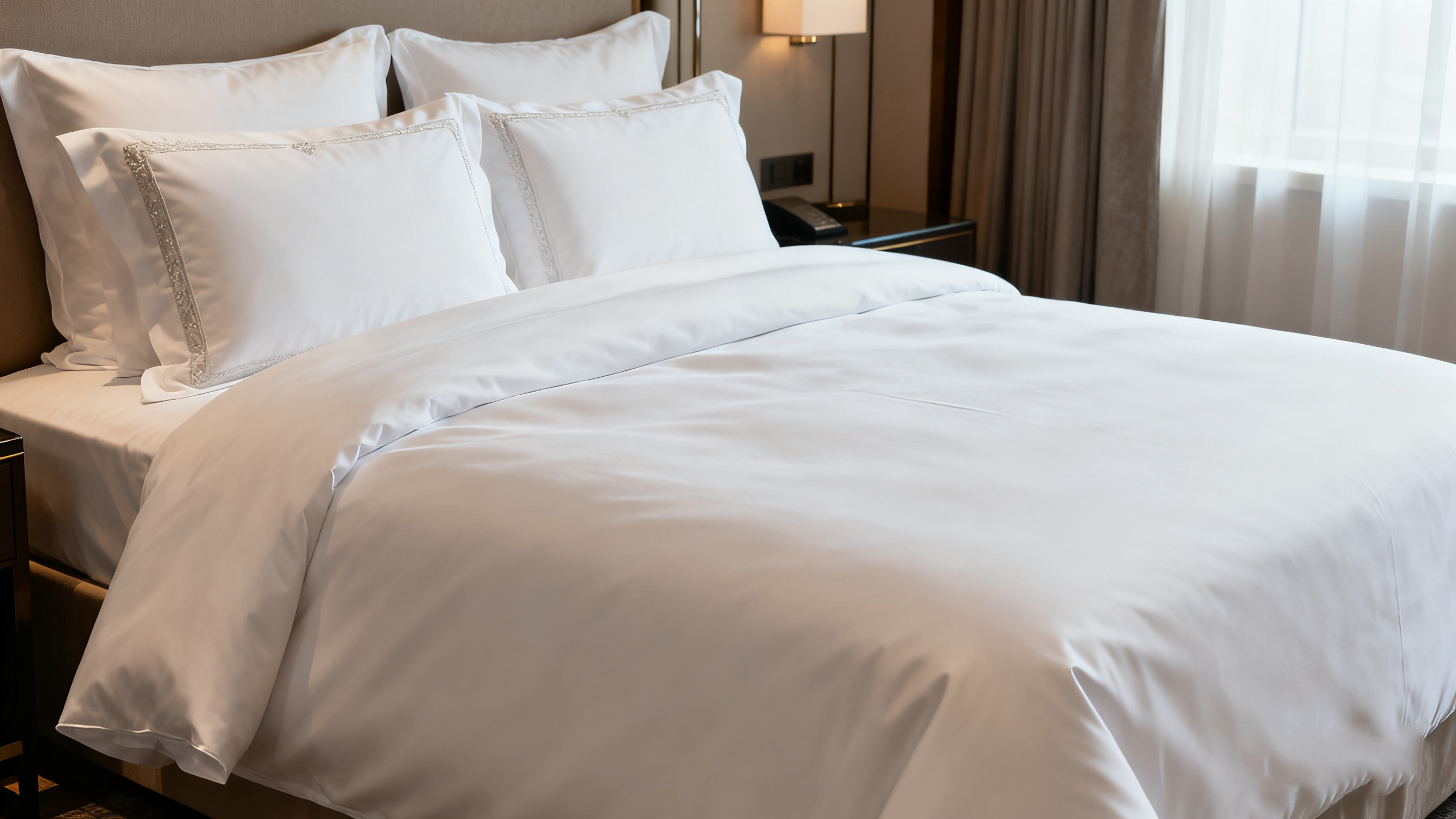
Chapter 2: Hotel Adaptation - Strategic Matching for Different Positioning
The type and positioning of the hotel serve as the ultimate guiding principle for determining the fabric of the bed sheets.
Luxurious five-star hotels, resorts and top-class boutique hotels
Preferred material: High-count and high-density pure cotton (such as 80-count or higher gauze, Egyptian cotton, Xinjiang cotton).
Adaptation logic: The core of competition for this type of hotel lies in providing an unparalleled guest experience. The ultimate comfort brought by the natural breathability and moisture absorption of cotton serves as the foundation for fulfilling the "luxurious sleep" promise. Its natural texture and slight wrinkles themselves become visual symbols of "high quality" and "naturalism". Here, the higher procurement and maintenance costs are regarded as necessary investments to ensure the core product strength.
2. Mid-range business hotels, select-service hotels and long-stay apartments
Strategic material: High-quality polyester/cotton blend or high-tech polyester (microfiber).
Adaptive logic: The key term in this field is "value balance". Guests need comfort, and hotels need efficiency.
Blended materials (such as 60% cotton/40% polyester) ingeniously combine the comfort of cotton with the durability of polyester, significantly reducing ironing costs, ensuring the quick turnover of guest rooms and the flatness of supplies, and are an extremely cost-effective choice.
High-tech polyester offers a smooth touch and exceptional durability, enabling the creation of a modern and intelligent living experience, meeting the demands of business travelers for efficiency and cleanliness.
3. Economy hotels, motels and properties with high turnover rates
Core material: Highly durable pure polyester bed sheets.
Adaptive logic: Cost control and operational efficiency are the lifelines. Polyester bed sheets have a significant advantage in procurement costs. Their extremely long lifespan and almost zero ironing requirements directly translate into higher profit margins. For guests who merely need basic sleep, their functionality is fully sufficient.
Chapter 3: Scenario Mapping - Precise Selection Based on Guests and Environment
In different situations, the quality of the materials will change dynamically.
Scenario A: Regions with hot and humid climate / Summer
Recommendation: Cotton bed sheets.
Reason: The breathable and moisture-absorbing properties of cotton are essential. It can effectively dissipate heat and sweat, preventing guests from waking up due to excessive heat and stickiness, thereby significantly improving sleep quality.
Scenario B: Hotel Dominated by Business Guests
Recommendation: Blended or high-quality polyester bed sheets.

Reason: Such guests place greater emphasis on efficiency and a neat appearance. The "meticulous" professional vibe conveyed by the ironed bed sheets is more in line with a business setting.
Scenario C: Hotels focusing on family-friendly or vacation experiences
Recommendation: Choose durable cotton or tightly blended bed sheets.
Reason: It is necessary to strike a balance between comfort and durability. We need to ensure the quality of rest while also being able to withstand possible accidental stains and frequent washing.
Scenario D: Spa Center or Hot Spring Hotel
Recommendation: High-absorbency pure cotton bed sheets.
Reason: After guests take a bath, their bodies carry moisture. The cotton bed sheets can quickly absorb this moisture, providing a dry and comfortable wrapping sensation, enhancing the relaxation experience after the spa treatment.
Chapter Four: The Essence of Selection - A Practical Guide for Hotel Procurement
When the theory is translated into actual purchasing actions, please follow the following key points.
Key Point 1: Conduct a total cost of ownership analysis
Do not merely focus on the purchase unit price. Please calculate the "total cost of ownership":
TCO = Purchase cost + Cleaning cost (water, electricity, detergent) + Labor cost (ironing, replacement) + Replacement frequency cost.
If an expensive pure cotton bed sheet has a doubled lifespan due to its durability and does not require frequent replacement and ironing, its TCO may be lower than that of cheaper products that need frequent replacement and ironing.
Key Point 2: Understand product labels and technical specifications
Component check: Make sure it is either "100% cotton" or "100% polyester fiber", or check the blend ratio.
Weave type and count (for cotton): 60-80 count satin weave is an excellent value option for high-end hotels. The higher the count, the smoother and denser the fabric will be.
Regarding technology (for polyester): Choose "superfine fibers". Ask the supplier if they have functional finishing technologies such as moisture absorption and sweat wicking.
Key Point 3: Practical Experience and Sample Testing
Sample testing: Request samples from the supplier, organize management and experienced housekeeping staff for a blind test, and evaluate the touch sensation, drape quality and overall comfort.
Pilot operation: Conduct a small-scale trial in some guest rooms and collect two key pieces of data:
The housekeeping department reported: Record the difficulty of washing, the drying time, and the degree of ironing requirements.
Guest feedback: Through questionnaires or online reviews, monitor the direct evaluations of guests regarding the comfort of the bedding.
Key Point 4: Elevate the choice to the strategic level of the brand.
Ultimately, your choice should resonate in harmony with the brand's commitment.
Choosing cotton is telling a story about "nature, luxury and craftsmanship".
Choosing high-tech polyester is conveying the concepts of "modernity, intelligence and efficiency".
Choosing recycled and environmentally friendly materials is a way to fulfill and demonstrate your social responsibility and sustainable values.
ReviewsNumber of comments: {{ page.total }}
I want to comment?
{{item.nickname ? (item.nickname.slice(0, 2) + '*****') : item.source === 1 ? 'mall buyer' : '--'}}
{{item.comment_time}}
Review in the {{item.country}}
Reviews
Merchant
{{replyItem.nickname ? (replyItem.nickname.slice(0, 2) + '*****') : replyItem.source === 1 ? 'mall buyer' : '--'}}
{{replyItem.parent_nickname ? (replyItem.parent_nickname.slice(0, 2) + '*****') : '--'}}
{{replyItem.is_merchant_reply === 1 ? replyItem.reply_time : replyItem.comment_time}}
Review in the {{replyItem.country}}
Reviews

No customer reviews
If you have more questions, write to us
Just leave your email or phone number in the contact form so we can send you a free quote for our wide range of designs!
Recommended
2023
01
11
We manufacture an extensive range of Premium and Luxury Bed linen, Bath linen, towels, Bed Sheets, mattress, pillows, and Hospital Linen products that are perfectly designed for the hospitality and hospital industry.
Telephone: 0771-5585836
Email: hanbiyan1@gmail.com
Phone: +86 15878178593
WhatsApp: +86 15878178593
WeChat: 15878178593
Address: Shop No. 201, 2nd Floor, Building 17, Nanning Country Garden Times City, No. 496 Kunlun Avenue, Santang Town, Xingning District, Nanning City, Guangxi Zhuang Autonomous Region
Copyright © 2026 HANBI - www.hanbi-hotelsupplies.com | Sitemap Privacy Policy