





Since the early stage of development, hanbi has integrated its service knowledge and concepts accumulated in the hotel industry into the company's management, deeply understood the high requirements of high-end hotels for quality and style, and always pursued high quality products and design innovation. In the past 20 years, hanbi has served high-star hotels in more than 130 countries. We all pursue the exquisite quality of the hotel, and experience the Korean won products now, and start to enjoy the quality of life higher than the star hotel
×
An article takes you through the material of hospital bed linen!
2025-01-09
When we walk into the hospital: white and clean sheets are one of the most common images in the ward.
But have you ever thought that these seemingly ordinary sheets have questions behind them, especially the materials
they choose, which are directly related to the patient's medical experience, the hospital's operating costs and the quality
of medical services. Today, I will take you to explore the various materials involved in hospital bed sheets.
1. Natural material - pure cotton
(1) Skin friendly and comfortable characteristics
Pure cotton material can be called the "old main force" of hospital bed sheets, which is based on natural cotton and has
unparalleled skin-friendly properties. For those patients who are in bed for a long time due to illness, the skin can feel soft
and gentle touch when it comes into contact with the pure cotton sheet, minimizing the discomfort caused by friction, as if
the fragile body is wrapped in a layer of gentle care.
(2) hygroscopic advantage
The hospital environment is complex, patients have different physical conditions, sweating, fluid leakage and other situations
occur. With excellent moisture absorption, cotton sheets can quickly absorb these moisture, keep the bed dry, reduce the risk
of skin problems caused by moisture, such as bedsores, eczema, etc., and create a good micro-environment for patients'
rehabilitation.
(3) Durability short board
However, cotton is not perfect. Frequent washing will make pure cotton sheets fall into a "dilemma", it is easy to shrink, deformation,
the original flat sheets may become wrinkled after a few times, and the size is no longer suitable for the bed. Moreover, after
long-term use and washing, pure cotton sheets will gradually harden, greatly reduce comfort, and their lack of durability makes the
replacement frequency relatively high, increasing the cost of the hospital.
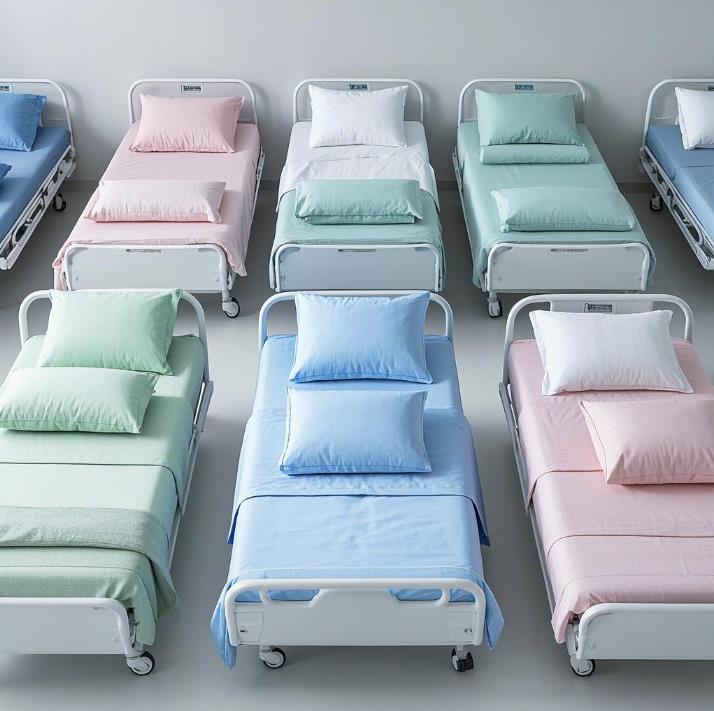
2, cost-effective choice - polyester-cotton blend
(1) Complementary performance
Polyester and cotton blend materials cleverly combine the characteristics of polyester and cotton, like a tacit partner. Polyester brings
high strength, so that the sheet can remain intact in frequent pulling and friction, and is not easy to break; Fast drying also solves the
problem of slow drying of pure cotton, greatly shortens the turnaround time of sheets from washing to putting into use again, and
improves the use efficiency of hospital linen.
(2) Cost consideration
From the point of view of cost, polyester-cotton blend undoubtedly has significant advantages. On the one hand, its procurement cost
is more affordable than pure cotton, which can save a considerable amount of expenses for hospitals with large-scale procurement. On
the other hand, lower replacement frequency and reduced drying costs allow the hospital to continue to benefit in the long-term operation,
achieving a better balance between cost and performance.
(3) Skin-friendly degree weighing
However, with the increase of polyester content in polyester-cotton blend, while improving durability, it also sacrifices a certain skin-friendly
feeling. Although the overall can still meet the basic needs of use, but for patients with sensitive skin, especially patients in pediatric and
dermatology wards, you may notice slight differences with pure cotton sheets.
3, high-tech pioneer - functional chemical fiber
(1) Antibacterial and antiviral "shield"
Functional chemical fiber materials are emerging in hospital Settings where the risk of fighting infection is extremely high. Some special fibers
are endowed with antibacterial and antiviral properties, which can effectively inhibit the breeding and spread of bacteria and viruses on the
surface of the bed sheet, and build a solid protective barrier for key departments such as the operating room, intensive care unit, and infection
department, greatly reducing the chance of cross-infection of patients.
(2) Special function expansion
In addition to antibacterial, functional chemical fiber can also have anti-static, anti-UV and other diversified functions. The antistatic function
prevents the bed sheet from absorbing dust and hair in a dry environment, and keeps it clean all the time. The UV protection function has its
use in some window beds or special departments to protect patients' sensitive skin from UV damage.
(3) Cost and breathability problems
However, such high-tech materials are often expensive, and the high procurement cost makes hospitals need to be cautious when choosing
them. In addition, in order to achieve special functions, some functional chemical fiber sheets compromise on air permeability, and long-term
use may make patients feel stuffy and uncomfortable, which limits its wide application to a certain extent.
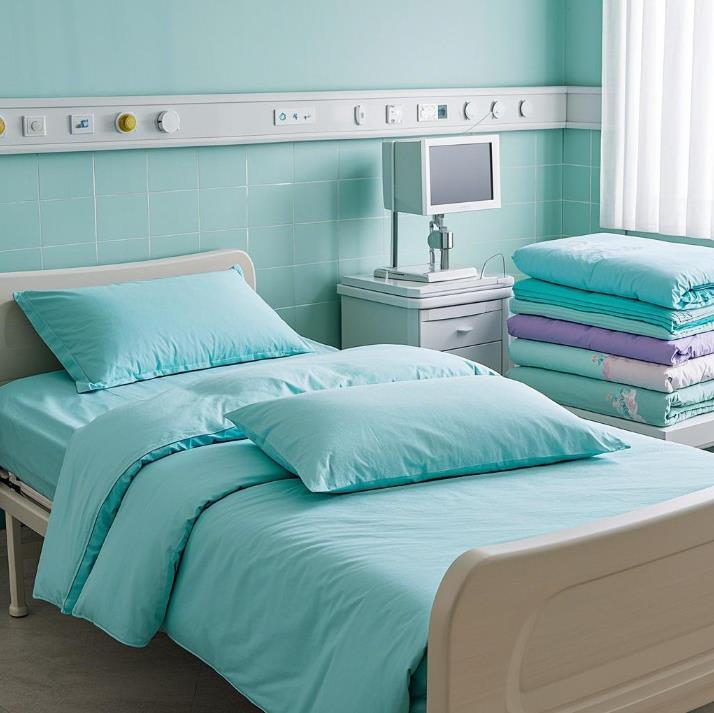
4. Select materials according to local conditions
(1) Practical choice of ordinary wards
For ordinary wards, the flow of people is relatively stable, most patients do not involve serious infection risk, polyester cotton blended bed sheet
with its cost-effective, easy to take care of the characteristics of the first choice. It can not only meet the comfort requirements of daily use, but
also perform well in cost control to ensure the stable and efficient supply of hospital linen.
(2) Accurate matching of key departments
The operating room, intensive care unit, hemodialysis room and other key departments can not be careless. In these areas, the sterile and hygienic
requirements are almost harsh, and the materials of pure cotton and functional chemical fiber are more favored. The outer layer uses antibacterial
functional chemical fiber to resist bacteria, and the inner layer uses pure cotton to close to the patient's skin, giving the patient the best protection
and comfortable experience, even if the cost is slightly higher, it is also a necessary investment to ensure medical safety.
5. Conclusion
The choice of hospital bed sheet material is not a simple decision, it is the result of comprehensive consideration of patient needs, hospital costs,
medical norms and other factors. By gaining a deeper understanding of the properties of different materials, hospital managers can make more
informed purchasing decisions, provide patients with a quality medical environment, and drive the quality of hospital services to a new level.
ReviewsNumber of comments: {{ page.total }}
I want to comment?
{{item.nickname ? (item.nickname.slice(0, 2) + '*****') : item.source === 1 ? 'mall buyer' : '--'}}
{{item.comment_time}}
Review in the {{item.country}}
Reviews
Merchant
{{replyItem.nickname ? (replyItem.nickname.slice(0, 2) + '*****') : replyItem.source === 1 ? 'mall buyer' : '--'}}
{{replyItem.parent_nickname ? (replyItem.parent_nickname.slice(0, 2) + '*****') : '--'}}
{{replyItem.is_merchant_reply === 1 ? replyItem.reply_time : replyItem.comment_time}}
Review in the {{replyItem.country}}
Reviews

No customer reviews
If you have more questions, write to us
Just leave your email or phone number in the contact form so we can send you a free quote for our wide range of designs!
Recommended
2023
01
11
We manufacture an extensive range of Premium and Luxury Bed linen, Bath linen, towels, Bed Sheets, mattress, pillows, and Hospital Linen products that are perfectly designed for the hospitality and hospital industry.
Telephone: 0771-5585836
Email: hanbiyan1@gmail.com
Phone: +86 15878178593
WhatsApp: +86 15878178593
WeChat: 15878178593
Address: Shop No. 201, 2nd Floor, Building 17, Nanning Country Garden Times City, No. 496 Kunlun Avenue, Santang Town, Xingning District, Nanning City, Guangxi Zhuang Autonomous Region
Copyright © 2026 HANBI - www.hanbi-hotelsupplies.com | Sitemap Privacy Policy