






Pure cotton bedding: The sleep art and detail philosophy of high-end hotels!
Hanbi focus on the development of environmentally friendly disposable products. The company has 20 patented technologies and an annual production capacity of 100 million sets. The main products include straw toothbrush, PLA comb and other degradable toiletry sets, with a degradation rate of more than 90%. Passed ISO9001 and ISO14001 certification, serving more than 500 customers. Hampe is committed to providing green solutions for the hotel industry, reducing plastic use by 300 tons per year.
Pure cotton bedding: The sleep art and detail philosophy of high-end hotels
In the covert rating system of hotel experiences, bedding has always been the core element for achieving "comfortable sleep". And pure cotton fabric, due to its natural skin-friendly, breathable and temperature-regulating properties, has become the preferred material for high-end hotels. It not only fulfills passengers' expectations for a good night's sleep, but also, with its exquisite craftsmanship and customizable design, becomes an important medium for hotels to convey their brand warmth.
1.High-end pure cotton material: The technological advancement of natural fibers
True luxury bedding starts with the control of the fiber source. The top hotel-exclusive pure cotton fabric usually uses 80-count or higher long-staple cotton yarns, and through a high-density weaving process (such as 400 threads per square inch density), it gives the fabric a silk-like luster and smooth texture. Taking the brocade weaving method as an example, its unique "one warp multiple wefts" structure makes the surface of the fabric present a fine and smooth texture, avoiding the friction during sleep while retaining the natural moisture absorption property of cotton fibers.
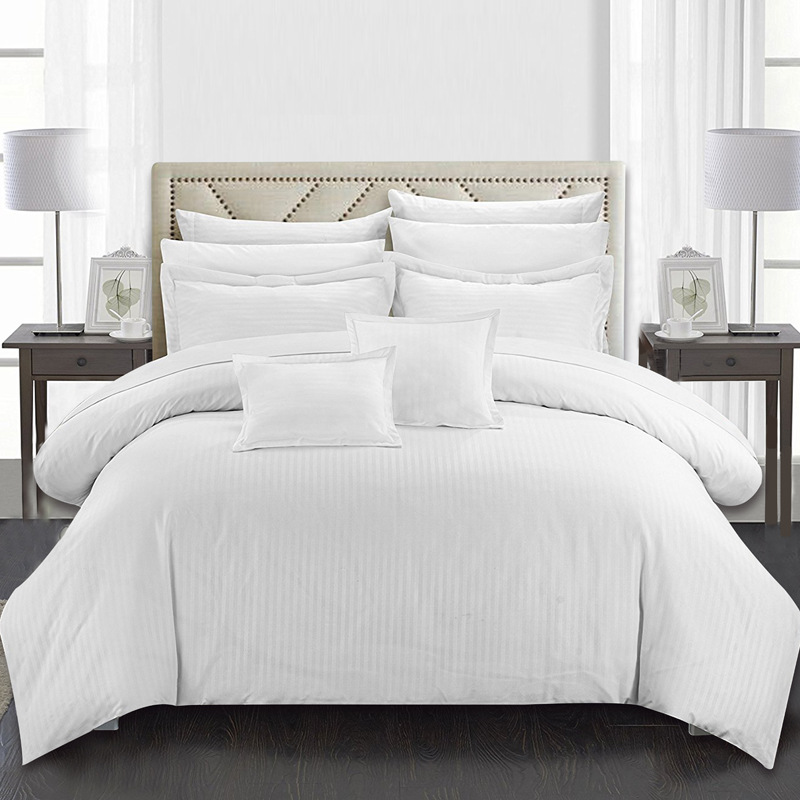
In the dyeing process, the application of reactive dyeing technology has significantly enhanced the durability and safety of the colors - the dye molecules react chemically with the cotton fibers, forming covalent bonds that ensure the pattern remains bright and new after 50 or more industrial washes. At the same time, it eliminates the residues of formaldehyde and heavy metals, meeting international environmental protection standards 48. For example, the digital printing series of a certain high-end supplier in Nantong, through nanoscale pigment penetration technology, makes the patterns both artistic and durable, becoming a popular choice for luxury hotels.
2. Comfortable and Skin-Friendly Experience: Ergonomic Fabric Expression
The "skin-friendly" feel of pure cotton is achieved through the synergy of multiple processes:
Physical softening: Through enzymatic washing, air flow smoothing and other techniques, the rough surface structure of the fibers is removed, making the texture as soft as clouds.
Biological polishing: The cellulose enzyme treatment removes the ends of microfibers, reducing frictional irritation on the skin. It is particularly suitable for people with sensitive skin.
Functionally speaking: The hydrophilic softener endows the fabric with pH balance properties, maintaining the stable micro-environment of the skin during sleep and preventing dryness or stickiness.
The actual measurement data of a hotel group shows that the customer satisfaction rate of guest rooms equipped with 400TC satin bedding reached 98.2%. Among them, the score for "touch comfort" was 37% higher than that of ordinary polyester-cotton blended products.
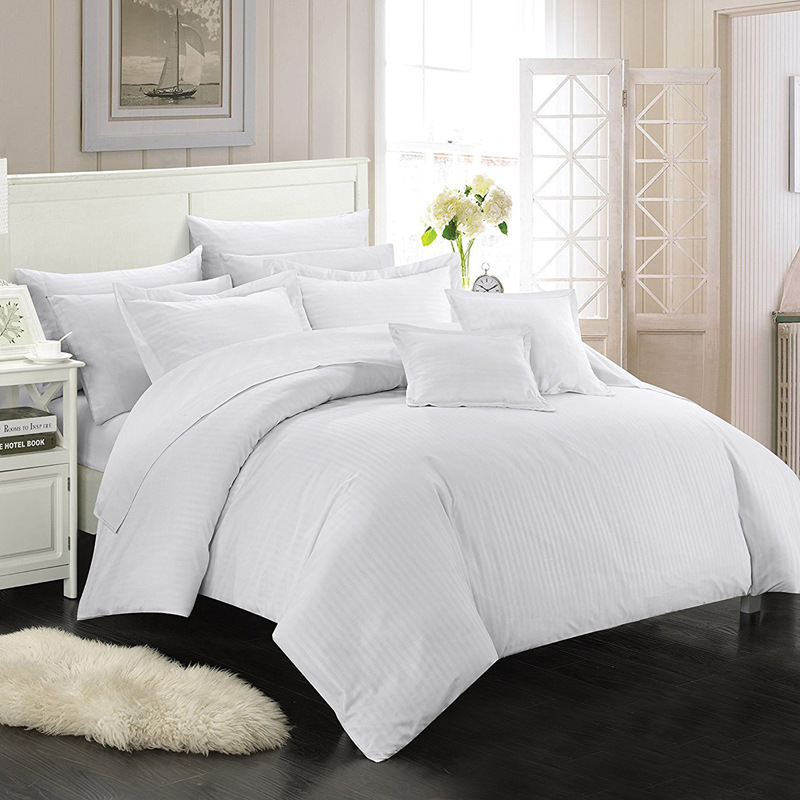
3. Moisture Absorption and Breathability Technology: The Wisdom of Microclimate Regulation
The natural hollow fiber structure of pure cotton can absorb 20% of its own weight in moisture without causing a damp feeling.
This characteristic is particularly important in regions with significant humidity fluctuations. Advanced techniques include:
Three-dimensional perforated weaving: Embedding micro-perforated channels on the basis of satin weave to accelerate heat exchange;
Wicking and moisture-wicking treatment: The surface of the fibers is grafted with hydrophilic groups, enhancing the capillary effect, allowing sweat to quickly diffuse and evaporate.
The comparative experiment shows that the optimized pure cotton bedding has a body temperature sensation 2.3℃ lower than that of ordinary fabrics at a temperature of 28℃, significantly reducing the frequency of turning over.
4. Washability and Durability Characteristics: The Revolution in Hotel Linen Lifecycle
High-end pure cotton bedding achieves industrial-grade durability through a triple reinforcement process:
Stitch reinforcement: The seams of the cover are sewn using the French needle-point technique, with a high-density thread of 12 stitches per inch, capable of withstanding a weight of over 50 kilograms.
Edge resistance to damage: The elastic band of the bed cover is embedded with nylon core-spun yarn. After being stretched 2000 times, the recovery rate still remains at 90%.
Wear-resistant treatment: A nano-silicon protective film is formed on the surface of the fibers. After 500 standard washes, the balling rate of the fibers is ≤ 0.5 grade.
With the professional care plan combining low-temperature drying and medium-temperature ironing, the service life can be extended to 3-5 years, significantly reducing the cost of linen replacement in hotels.
5. Minimalist Aesthetic Design: The "Less is More" Philosophy of Sleep
Modern hotel bedding design is moving from complexity to simplicity:
Application of Color Psychology: Utilizing low-saturation earth tones (such as gray-brown, misty blue, and oatmeal white) as the main color scheme to trigger the relaxation response of alpha brain waves;
Details of the invisible function: The cover is secretly equipped with a 10cm waterproof strip inside (to prevent cosmetic contamination), and the bed cover is designed to be 20-30cm tall to fit the memory foam mattress.
Cultural Element Highlight: Through jacquard or embroidery techniques, regional symbols (such as Suzhou embroidery bamboo patterns, Nordic geometric lines) are incorporated into the pillowcases and bed edges, subtly conveying the brand story.