





The secret of hotel towel luxury: Why are the towels in five-star hotels always so perfect?
The secret of hotel towel luxury: Why are the towels in five-star hotels always so perfect?
When you stay in a luxury hotel, have you ever noticed the pleasant experience brought by those white and soft towels? What about the fluffy and thick texture, the super absorbent property, and the long-lasting quality? What are the hidden production secrets behind them? This article will take you deep into the world of hotel towels and reveal the exquisite craftsmanship and technical details that make ordinary towels pale in comparison.
Xinjiang Longyin Cotton: The Gold Standard in Towel Industry :
Top hotels around the world unanimously choose Xinjiang's long-staple cotton as the raw material for their towels. This is no coincidence. Xinjiang's unique natural conditions - an annual sunshine duration of 2,800 hours, a continental climate with large day-night temperature differences, and irrigation from the snow water of the Tianshan Mountains - create an ideal environment for cotton growth.
The fibers of Xinjiang long-staple cotton can reach 35-40 millimeters in length, which is over 30% longer than those of ordinary cotton. Longer fibers mean that fewer fiber ends are exposed on the surface, thereby reducing pilling and hair loss. At the same time, long fibers can be spun into finer and stronger yarns, making towels softer and more durable.
These ultra-long fibers also create more internal space, allowing the towels to absorb more water. Tests have shown that high-quality Xinjiang cotton towels have a 40% faster water absorption rate than ordinary towels, and can absorb 60% more water. This is precisely why hotel towels can always quickly dry the body.
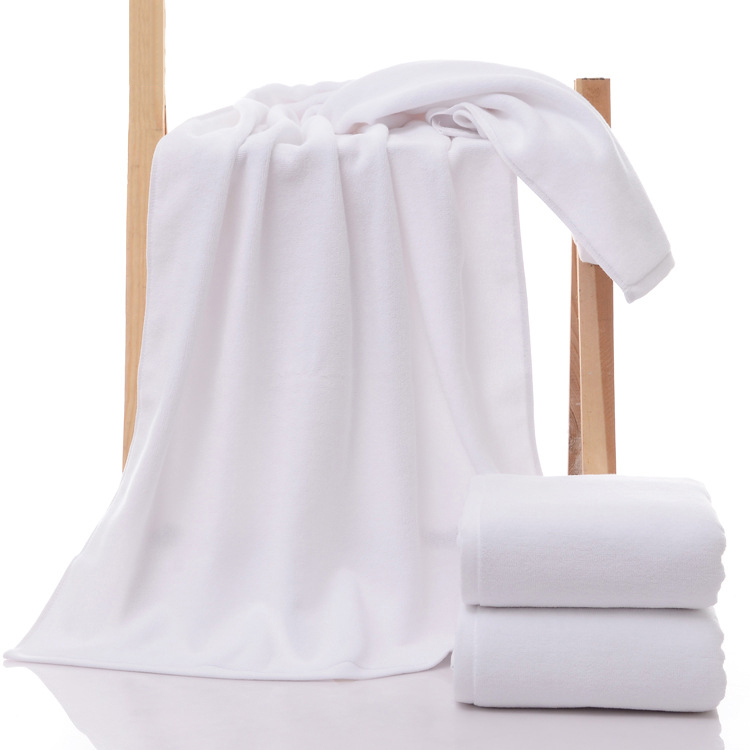
The scientific beauty of the high-count and high-density weaving technique:
The high-count and high-density weaving technique used for hotel towels is a sophisticated technical achievement. "Count" refers to the length of the yarn spun from one pound of cotton. The higher the count, the finer and softer the yarn. "Density" refers to the number of warp and weft threads per square inch. The higher the density, the thicker and more durable the towel.
The towels in high-end hotels usually follow the standard of 30 threads per square inch and 600 grams or more. This means:
There are more than 20,000 cotton fibers per square inch.
The weight of the towel exceeds 600gsm (grams per square meter).
The height of the hair ring should be maintained within the optimal range of 3 to 5 mm.
This high-density structure not only offers excellent water absorption properties, but also ensures the durability of the towels. Laboratory tests have shown that high-quality hotel towels can withstand more than 200 industrial washes and remain in good condition, while ordinary household towels usually start to deteriorate after 50 to 70 washes.
Satin finishing technique: The perfect combination of beauty and functionality:
Carefully examine the hotel towels and you will notice that there are smooth and shiny strip-like areas at both ends. This is the satin finish technique. The satin finish is achieved through satin weaving, which contrasts sharply with the looped texture of the main body of the towel.
The satin cover is not only beautiful but also has practical functions:
Strengthen the structure of the towel to prevent stretching and deformation
Provide a designated area for brand logo. The hotel can embroider the logo on this area.
Create visual contrast to enhance the premium feel of the product
Reduce edge wear and extend service life
The satin weaving technique demands extremely high precision. The warp and weft density needs to reach over 200 threads per square inch, which is more than twice the density of the towel body. This tight weaving method effectively reduces the hair loss rate of the towel because fewer fiber ends are exposed.
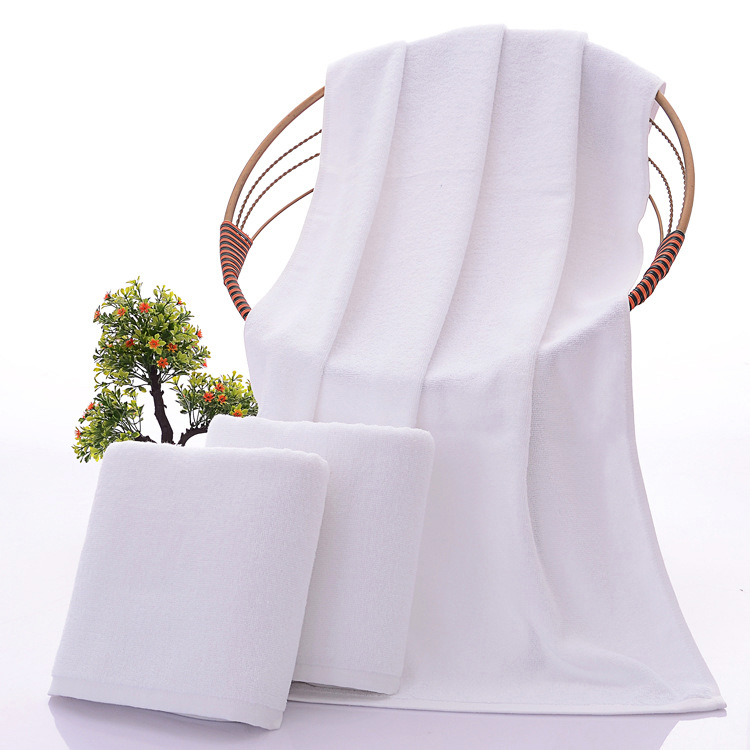
Active Dyeing: Dual Assurance of Color and Health
Hotel towels are mostly in pure white color, but some high-end resort hotels may also use light-colored towels. The secret behind these brightly colored yet non-fading towels lies in the reactive dyeing technology.
Unlike ordinary coating printing and dyeing, reactive dyeing causes the dye molecules to form covalent bonds with the cotton fibers, becoming part of the fibers. This chemical bonding results in:
The color durability has been enhanced by 3 to 5 times, and it remains as bright as new even after multiple washes.
Does not affect the breathability and water absorption of the towel
Does not contain harmful substances and complies with human safety standards:
The reactive dyeing process requires precise control of temperature, pH value and time. Each color requires specific formulations and process parameters. The complexity of this technology is also one of the reasons why high-end towels have higher prices.
Coarse Loop Structure: Scientific Analysis of Water Absorption Properties
The absorbency of towels mainly comes from their pile structure. Hotel towels adopt a very high pile design (usually 3-5mm), and these upright ring-shaped structures create a huge surface area.
The scientific principle is quite simple: More surface area means more water molecules can combine with cotton fibers through hydrogen bonds. The pile density of high-quality hotel towels reaches over 200 per square inch, which means a standard bath towel has more than 20 million microscopic "water storage units".
These tufts have also undergone special treatment to maintain an upright position. The combing process removes shorter fibers, leaving only long and strong fibers, making the tufts more uniform and neat. The high-temperature steam setting ensures that the tufts remain in their best condition after use and washing.
