





Since the early stage of development, hanbi has integrated its service knowledge and concepts accumulated in the hotel industry into the company's management, deeply understood the high requirements of high-end hotels for quality and style, and always pursued high quality products and design innovation. In the past 20 years, hanbi has served high-star hotels in more than 130 countries. We all pursue the exquisite quality of the hotel, and experience the Korean won products now, and start to enjoy the quality of life higher than the star hotel
×
When choosing hotel bedding, how to judge the quality of the fabric?
2025-01-24
In the selection of hotel bedding, the quality of fabric can be judged from the following aspects:
Observation appearance
Color: Quality fabric color uniform, natural, soft, no obvious color difference. If the color of the fabric is too bright and
dazzling, or there are different shades, it may be that the printing and dyeing process is not up to standard and the quality
is poor. For example, a good cotton white bed, the color is natural white, not that kind of pale or with variegated color.
Texture: Carefully check the texture of the fabric is clear and regular. Fabrics with clear textures and delicate patterns are
usually better woven. Like high-count and high-density fabrics, their texture will be more delicate and compact, while
low-quality fabrics may be fuzzy and sparse.
Defects: Check the surface of the fabric for spots, stains, holes, jumpers and other defects. Even minor defects may affect
the use and beauty of the bed, and high-quality fabrics should be clean and tidy without any defects.
Touch texture
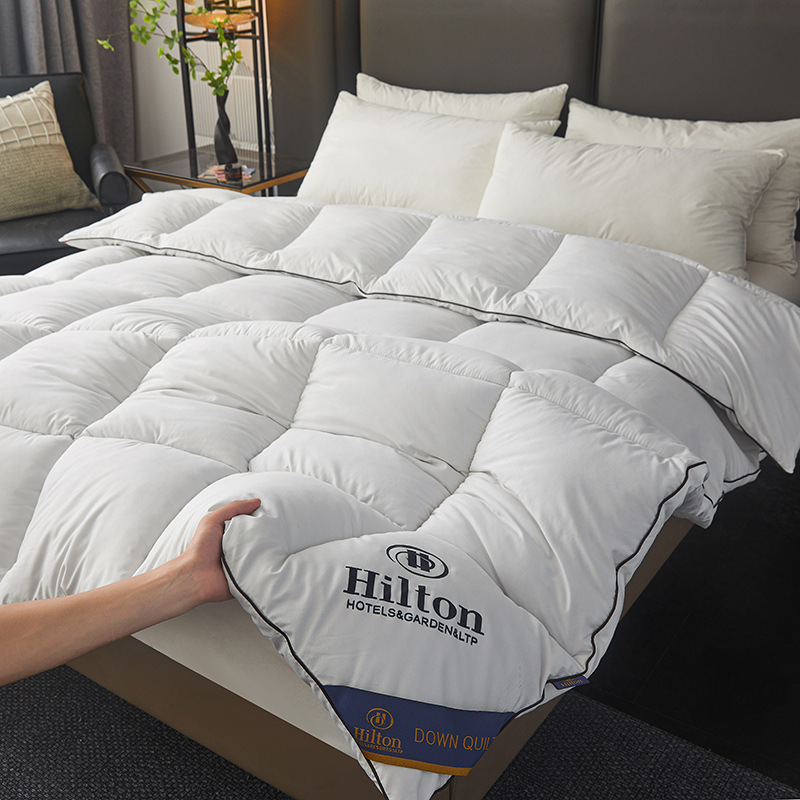
Softness: Touch the fabric with your hands to feel its softness. Good fabric feel soft and smooth, no rough, prickly feeling.
Silk fabrics, for example, feel smooth and silky to the touch, while poor quality chemical fiber fabrics may have a stiff, stinging
touch.
Thickness and weight: The appropriate thickness and weight can reflect the quality and quality of the fabric. In general,
under the same material, the fabric weight is higher, relatively thicker, and the quality is better, but it also needs to be combined
with specific needs, such as summer bedding may be more suitable for light and light fabrics.
Elasticity: Gently pull the fabric and observe its elasticity. High quality fabric can be quickly restored to its original state after
stretching, with good elasticity and easy deformation. Like elastic knitted fabrics, they can bounce back quickly after stretching,
while poor quality fabrics may be relaxed and difficult to recover.
Test performance
Water absorption: For hotel bedding, especially towels, sheets, etc., water absorption is very important. You can drop a few
drops of water on the fabric and observe the absorption of the drops. If the water droplets can be quickly absorbed, it indicates
that the fabric has good water absorption, fiber quality and weaving process. On the contrary, the water droplets do not penetrate
for a long time, indicating that the fabric may have been water-repellent finishing or poor quality.
Breathability: Hold the fabric close to the mouth and nose and gently exhale to feel how easy it is for air to penetrate the fabric.
Fabrics with good air permeability can make the skin "breathe" and be more comfortable to use, such as linen fabrics with good air
permeability, while some thickly coated fabrics have poor air permeability.
Resistance to pilling: Rub the fabric back and forth several times with your hand to see if it is easy to pilling. High quality fabric after
good treatment, fiber bond tightly, not easy to pilling; And poor quality fabrics, especially some fabrics with high chemical fiber content,
may quickly pilling.
Understand ingredients and labeling
Ingredient content: Check the ingredient label for the specific composition and content of the fabric. For example, the cotton content
of pure cotton fabrics should generally be more than 75%, and the cotton content of fabrics labeled as "100% cotton" should meet the
requirements of national standards. If the ingredient labeling is not clear or accurate, it may be a product of unreliable quality.
Safety standards: Pay attention to whether the fabric meets the relevant safety standards, such as whether it contains formaldehyde,
aromatic amine and other substances that are harmful to the human body. Qualified bed products will have the corresponding safety
marks, such as in line with the national Class A or Class B standards, class A standards are more suitable for infants and children and
sensitive skin groups, and the safety level is higher.
ReviewsNumber of comments: {{ page.total }}
I want to comment?
{{item.nickname ? (item.nickname.slice(0, 2) + '*****') : item.source === 1 ? 'mall buyer' : '--'}}
{{item.comment_time}}
Review in the {{item.country}}
Reviews
Merchant
{{replyItem.nickname ? (replyItem.nickname.slice(0, 2) + '*****') : replyItem.source === 1 ? 'mall buyer' : '--'}}
{{replyItem.parent_nickname ? (replyItem.parent_nickname.slice(0, 2) + '*****') : '--'}}
{{replyItem.is_merchant_reply === 1 ? replyItem.reply_time : replyItem.comment_time}}
Review in the {{replyItem.country}}
Reviews

No customer reviews
If you have more questions, write to us
Just leave your email or phone number in the contact form so we can send you a free quote for our wide range of designs!
Recommended
2023
01
11
We manufacture an extensive range of Premium and Luxury Bed linen, Bath linen, towels, Bed Sheets, mattress, pillows, and Hospital Linen products that are perfectly designed for the hospitality and hospital industry.
Telephone: 0771-5585836
Email: hanbiyan1@gmail.com
Phone: +86 15878178593
WhatsApp: +86 15878178593
WeChat: 15878178593
Address: Shop No. 201, 2nd Floor, Building 17, Nanning Country Garden Times City, No. 496 Kunlun Avenue, Santang Town, Xingning District, Nanning City, Guangxi Zhuang Autonomous Region
Copyright © 2026 HANBI - www.hanbi-hotelsupplies.com | Sitemap Privacy Policy