





Hotel Bedding Selection Guide: A Comprehensive Analysis from Materials to Craftsmanship!
Hotel Bedding Selection Guide: A Comprehensive Analysis from Materials to Craftsmanship
In today's highly competitive hotel industry, a comfortable bed often becomes the key factor for guests to make their next choice.
As an integral part of the hotel's core experience, the quality of bedding directly affects the guests' sleep quality and their overall impression of the hotel. A survey indicates that over 70% of hotel guests consider the comfort of the bedding to be one of the important criteria when evaluating a hotel.
As a hotel supplier, we will provide you with a professional guide for selecting hotel bedding from multiple perspectives including material comparison, quality of yarn, choice of craftsmanship, and production capabilities of the factories.
1.In-depth Analysis of Hotel Bedding Materials
The material of hotel bedding is the primary factor determining comfort. Different materials will provide guests with completely different sleep experiences.
The common fabrics used in hotels currently include 40s and 60s. Some high-end hotels may choose 80s fabrics. The 60s yarn is finer than the 40s yarn, with fewer defects, a denser and thinner texture, and better softness and comfort.
Cotton materials have become the preferred choice for hotels due to their breathability and comfort. However, within the cotton category, there is also a clear distinction in quality levels:
Long-staple cotton: The highest grade of cotton, with long fibers, high strength, strong water absorption, presenting a silk-like luster. The fiber length is generally over 33mm, and can even reach 60-70mm.
Fine-wool cotton: The most common type of cotton. Currently, most affordable cotton textiles use fine-wool cotton, with cotton fibers ranging in length from 23 to 33 millimeters.
Coarse-fiber cotton: Cotton that has been discarded, with low yield and thick, short fibers, not suitable for machine weaving.
Superior cotton is the preferred choice for high-end hotels. Its fibers are long, soft, white and lustrous, with good elasticity. Compared with Egyptian cotton and Pima cotton, Xinjiang superior cotton offers better value for money and has become a hot commodity in the market in recent years.
Apart from the type of cotton, the weaving method of the fabric also directly affects the texture and durability of the bedding. The common weaving methods used in hotels are mainly three types:
Plain weave: More interlacing points, firm texture, smooth surface, good wear resistance and good breathability.
Sweat-resistant fabric: The warp and weft threads interweave at least every two threads, making it relatively thick and having a soft feel.
Satin: It has a soft texture and good luster. It is the densest and thickest among fabrics.

2. Yarn Quality and Process Selection
Yarn count is the most fundamental unit that constitutes the finished fabric, and it is also an important indicator determining the softness and luster of the fabric.
The yarn count is generally classified as follows: coarse yarn (below 18s), medium yarn (19s - 29s), fine yarn (30s - 60s), and super fine yarn (above 60s). The larger the yarn count number, the finer the yarn, and the thinner the fabric it produces. The texture will be softer and the luster will be better.
60s yarn is an important reference indicator for hotel bedding. Fabrics woven from 60s yarn have good luster, moderate thickness, and balance both durability and comfort. They also take into account the body sensation in both winter and summer, making them a reasonable choice for hotels.
Density indicates the amount of material used in the fabric and is the most important indicator for evaluating the quality of the fabric. For example, if there are 133 warp yarns and 72 weft yarns, the density would be 133 * 72.
Under the same thread count, the most important factor is the density. The higher the density, the denser the fabric and the heavier the weight.
The bedding of high-end hotels usually uses yarn with a length of 60s or longer, and the density reaches above 300TC. For example, the fabric of 80s/500TC has a delicate touch and a luster like silk.
Most budget hotels use yarn from the 40s to 60s range, with a density of around 200TC. This balance cost and comfort.
In terms of craftsmanship, the jacquard patterns are divided into small jacquards and large jacquards. The yarn count is very fine, and the requirements for raw materials are extremely high. However, they have strong decorative properties, good draping and breathability, high color fastness, and can meet the personalized needs of hotels.
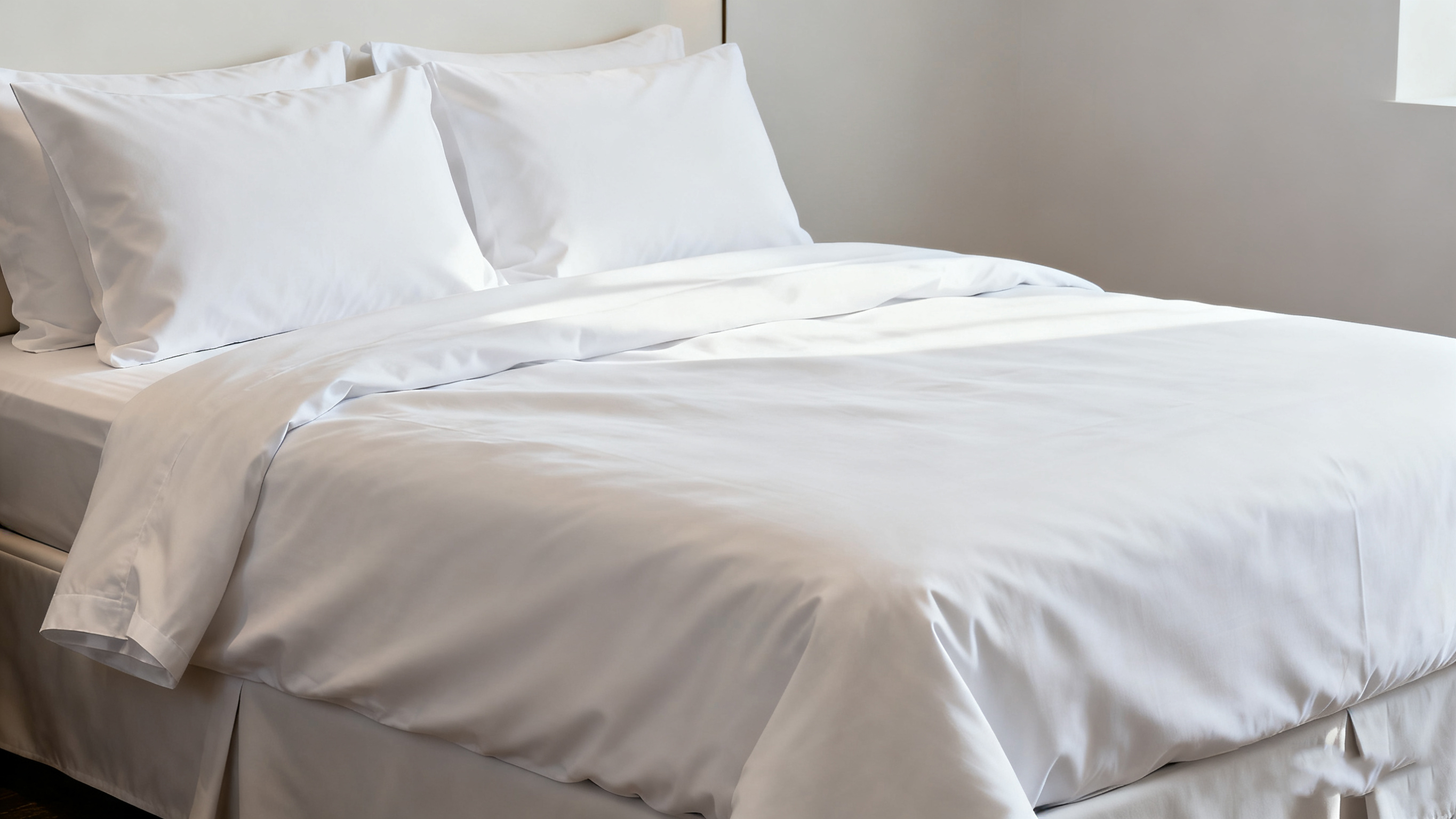
3. How to assess production capabilities and select hotel bedding
Hotel bedding procurement requires comprehensive consideration of multiple factors, including material, craftsmanship, supplier strength, and cost control, etc.
When selecting suppliers, the production capabilities of the factory are the foundation for ensuring the stability of bedding quality. A factory with a complete production chain can control the quality from the very beginning.
Take Henan Mushi Trading Company as an example. It has established eight production units including weaving, cotton processing, and embroidery in Zhengzhou and Puyang. More than 300 looms have achieved full self-production from "raw materials to finished products".
This full-chain production model completely resolves the quality control issues of OEM products - the 160-thread-count long-staple cotton bedding products can maintain a 3-level anti-torn-out standard after 500 washes, far exceeding the 2-level requirement of the national standard.
When choosing hotel bedding, the first step is to determine the purchasing requirements, including the room type and style, the guests' needs, and the budget range.
Next, it is necessary to select high-quality materials. For bed sheets and pillowcases, pure cotton or high-count pure cotton materials are preferred. For the pillowcases and mattress pads, different fillings should be chosen according to the changing seasons.
Pay attention to the design and matching. Select colors and patterns that are in harmony with the hotel's decoration style.
Considering practicality and durability, choose bedding that is easy to clean and maintain, has good wear resistance and strong anti-wrinkle properties.
When cooperating with suppliers, it is necessary to conduct multiple price comparisons, require suppliers to provide samples for testing, and establish long-term cooperation with reputable suppliers.
4. The core advantages of Hanbi Textiles
Among the numerous hotel bedding suppliers, Hanpi Textiles has stood out due to its unique advantages. By aligning with industry standards, we can infer that its advantages might lie in the following aspects:
Full-chain production capacity: Hanbi may possess a complete production line from raw materials to finished products, ensuring controllable product quality.
Selection of high-quality materials: May focus on premium materials such as long-staple cotton, with long fibers, high strength and strong water absorption.
Precision manufacturing technology: It may employ weaving techniques with a thread count of over 60s, combined with advanced weaving processes such as satin or jacquard, to ensure that the product is both aesthetically pleasing and durable.
Environmental certification: May obtain international certifications such as OEKO-TEX STANDARD 100, ensuring that the products do not contain harmful substances and meeting the environmental requirements of modern hotels.
Customized services: We may be able to meet "small batch, multiple styles" customization requirements, including size adjustments, logo embroidery, and customization of washing labels, etc.
For chain hotels, establishing long-term partnerships with suppliers with full-chain production capabilities not only ensures quality but also reduces procurement costs through large-scale production. A case where the actual replacement cycle was extended from 8 months to 22 months, and the annual loss cost was reduced by 37%, is precisely the long-term return brought by high-quality bedding.
