





The material code of hotel bedding: From pure cotton to luxurious jacquard brocade decoding !
The material code of hotel bedding: From pure cotton to luxurious jacquard brocade decoding
In the covert evaluation system of high-end hotels, bedding has long transcended its simple role as a sleep tool and has become the core weapon in shaping the "cloud sleep experience". When guests sink into those memorable hotel beds, what their bodies perceive is actually the result of the combined effect of precise fabric science and supply chain strategies.
1.Comprehensive Material Analysis: The Scientific Atlas of Hotel Textiles
Cotton fabric: It accounts for over 80% of the market share in luxury hotels.
Long-staple cotton (Egyptian cotton/Giza 45, Supima cotton) is preferred by top hotels because its fibers are over 34mm in length, enabling the production of finer and more durable yarns.
Misconception about yarn density: Contrary to common belief, luxury hotels typically use a density of 200-400 threads per inch - a higher density of 200 threads per inch (percale) offers a cool and breathable feel, while a density of 300-400 threads per inch (sateen) provides a silky smooth texture.
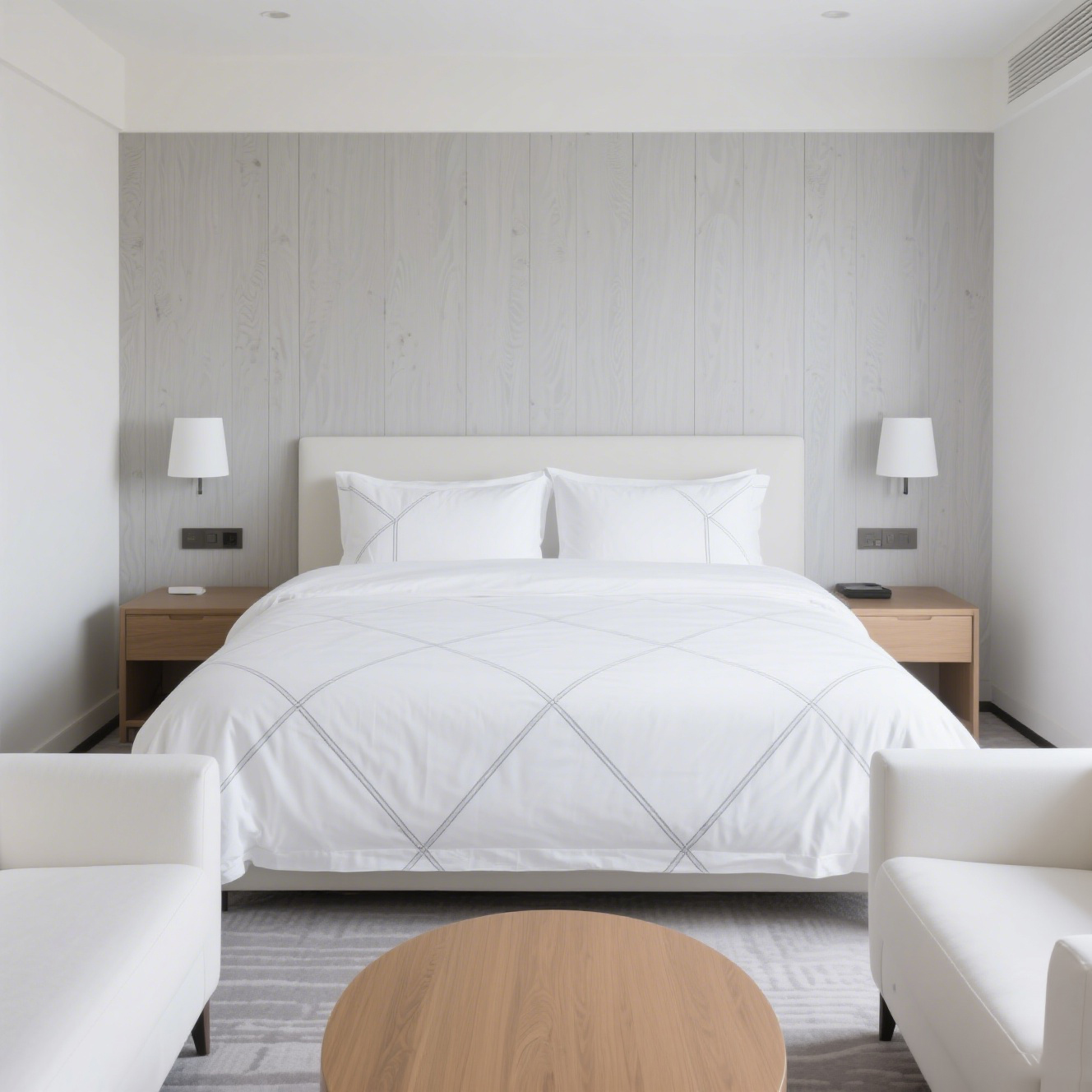
White Dominance: 95% of five-star hotels use pure white bedding, as it can be washed at high temperatures to kill bacteria and visually convey a sense of cleanliness. Combined with the invisible stitching technique, it enhances the minimalist aesthetic.
Satin weave technique: The "light-responsive shaper" of cotton fibers
Pure cotton white satin stripe: A glossy stripe formed by a satin weave (with 4-5 floats of warp yarns). It is mostly used in mid-range hotel brands such as Holiday Inn, and its cost is 15%-20% higher than that of plain colors.
Cotton-synthetic satin strips (65/35 blend): The blend ratio is an "cost-saving tool" for budget hotels - while maintaining 60% cotton feel, the wrinkle resistance is enhanced by 40%, and the drying time is shortened by 30%.
Gongdan jacquard: The relief art on the loom
Process cost: The fabric is woven using electronic jacquard machines. The yarn density needs to be above 400 to display fine patterns. The material cost is 25% to 50% higher than that of ordinary satin weave.
Class differentiation:
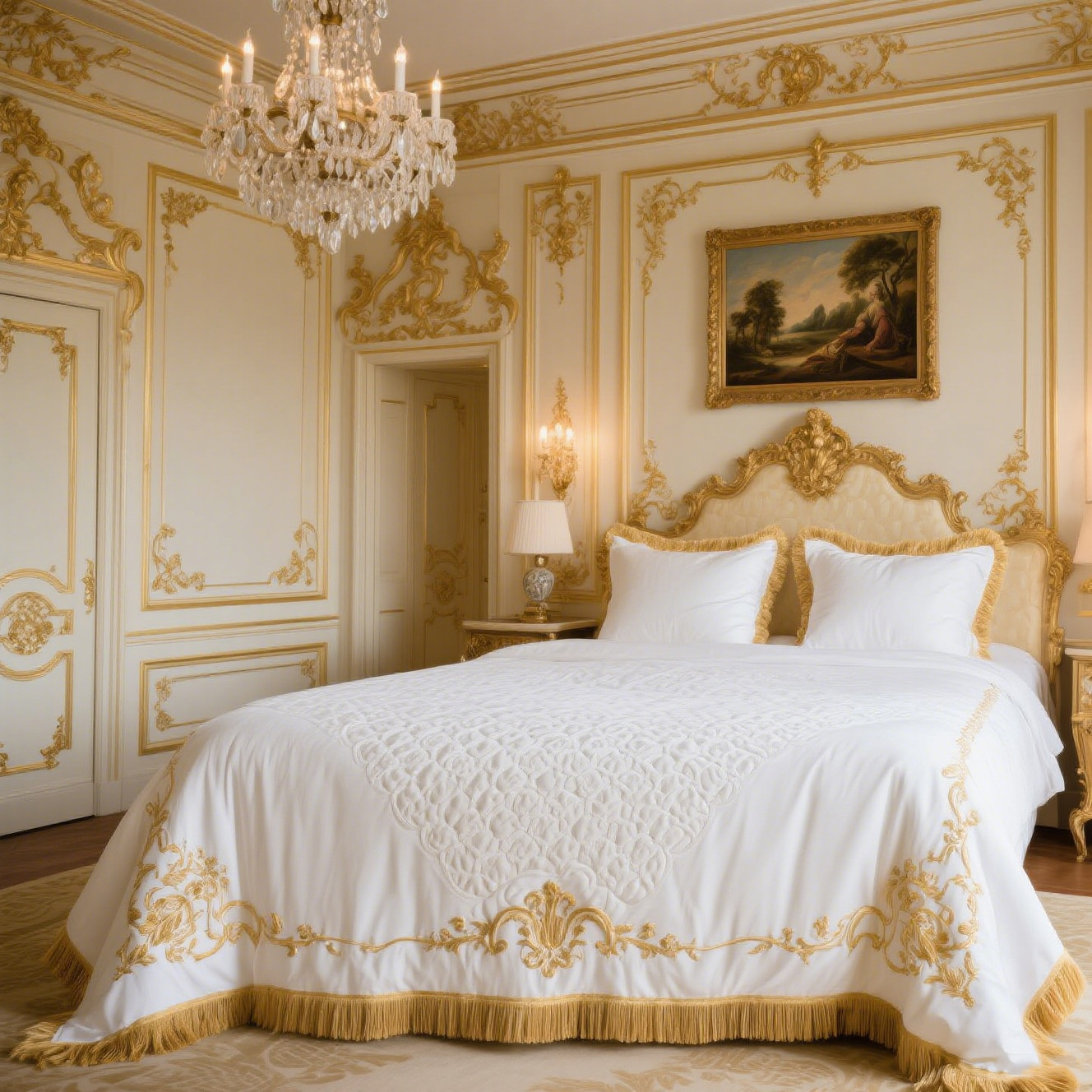
Luxury Hotel: 100% Supple Cotton + Invisible Jacquard (Hidden Logo, Geometric Texture)
Mid-range hotel: Blended fabric base + pure cotton jacquard, highlighting the visual three-dimensionality
Economic chain: Printing replaces jacquard, reducing the cost per square meter by 60%
2. Hotel Classification Configuration Diagram: A Revolution in Sleeping Arrangements from Economy Class to First Class
Luxury Camp (Ritz-Carlton / Four Seasons)
Material combination: Giza 45 Egyptian cotton + 80-count double-ply plain weave, sewn with an Italian angled seam treatment
Washing standard: 200 industrial wash cycles, combined with plant enzyme cleaner to maintain fiber elasticity
Supply chain: Customized by century-old workshops in Portugal, the cost of a single set reaches $800.
Mid-range (Marriott / Hilton Garden )
Cost reduction strategy: Use American Pima cotton with 50-count satin weave, and the blended ratio should be 80% cotton and 20% polyester.
Visual upgrade: Pure cotton satin strip edging, combined with a 5cm-wide decorative band, enhances the luxurious feel.
Washing optimization: Resistant to 150 washes, with color fastness reaching grade 4 or above.
Economy chain (such as Jiage / Hanting)
Blend dominant: 50/50 polyester-cotton plain weave, yarn weaving density 120-150 strands
Quick turnover design: Drying time has been reduced to 45 minutes (for pure cotton, it was 70 minutes or more)
3. The battle between pure cotton and blended fabrics: A triangular trade-off of cost, texture, and durability
The "luxury logic" of pure cotton
Re-purchase Engine: 78% of guests rank "bedding texture" as the primary reason for re-visiting the hotel. The softening property of long-staple cotton (which reaches a comfortable peak after 50 washes) forms an experience memory point.
Respiratory advantage: The rate of moisture and heat transfer is three times faster than that of blended fabrics. In subtropical regions, it can reduce air conditioning energy consumption by 15%.
Blended "commercialism"
Life-cycle cost: Taking a polyester-cotton blended fabric as an example:
The procurement cost has been reduced by 30% to 50%.
Washing energy consumption reduced by 25% (lower moisture content shortens drying time)
The service life has been extended by 40% (the tear resistance is 1.8 times that of pure cotton)
Management efficiency: Wrinkle resistance reduced by 70%, ironing time decreased by 35%, room service staff bed-making efficiency increased by 35%
As a top-tier supplier serving major groups such as Huazhu and Jinjiang, Hanpi Textile Co., Ltd. has restructured the value chain by providing a five-star room configuration solution:
Vertical production: The integrated control from cotton procurement in Egypt to jacquard weaving has reduced the cost of using 400 satin jacquard threads in mid-range hotels by 40%.
Intelligent Supply Chain:
RFID fabric tracking system: Real-time monitoring of washing frequency/fiber strength attenuation, precise prediction of replacement cycle
3D weaving simulation: Customers can adjust the satin strip width/fabrication depth on the cloud. The sample production cycle has been shortened from 14 days to 72 hours.
Sustainable Process:
Dry dyeing technology: Applied to pure cotton satin products, reducing water consumption by 89%
Recycled polyester blend: Using recycled PET bottles to produce polyester components, reducing the carbon footprint by 65%
4. Sustainability: The Essential Question for Future Hotel Textiles
Material Revolution: Radisson Hotel piloted lyocell (teak fiber) blended fabric, which is 30% stronger than cotton and requires 50% less water.
Closed-loop system: Marriott initiates bedding recycling program, where old cotton fibers are re-spun into carpet padding, and polyester components are decomposed into recycled raw materials.
Digital Twin: Hilton increased the accuracy of bedding replacement decisions by 98% and reduced waste by 22% through AI fabric lifespan monitoring.
