





The "scientific sleep revolution" of pure cotton - the quality secret of five-star hotels !
The "scientific sleep revolution" of pure cotton - the quality secret of five-star hotels
1.Pure cotton, physiological-level sleep science
Microclimate regulation: The hollow structure of cotton fibers (with a cavity ratio of 40%) can absorb 500ml of sweat every night, maintaining a constant temperature range of 32-34℃ in the bed. This results in an increase of 25 minutes in the duration of deep sleep.
Health protection efficacy: The anti-mite performance of untreated cotton fibers is three times higher than that of wool. Combined with industrial ironing at 130℃, it can achieve 100% mite removal, reducing the rate of allergy complaints in hotel rooms by 45%.
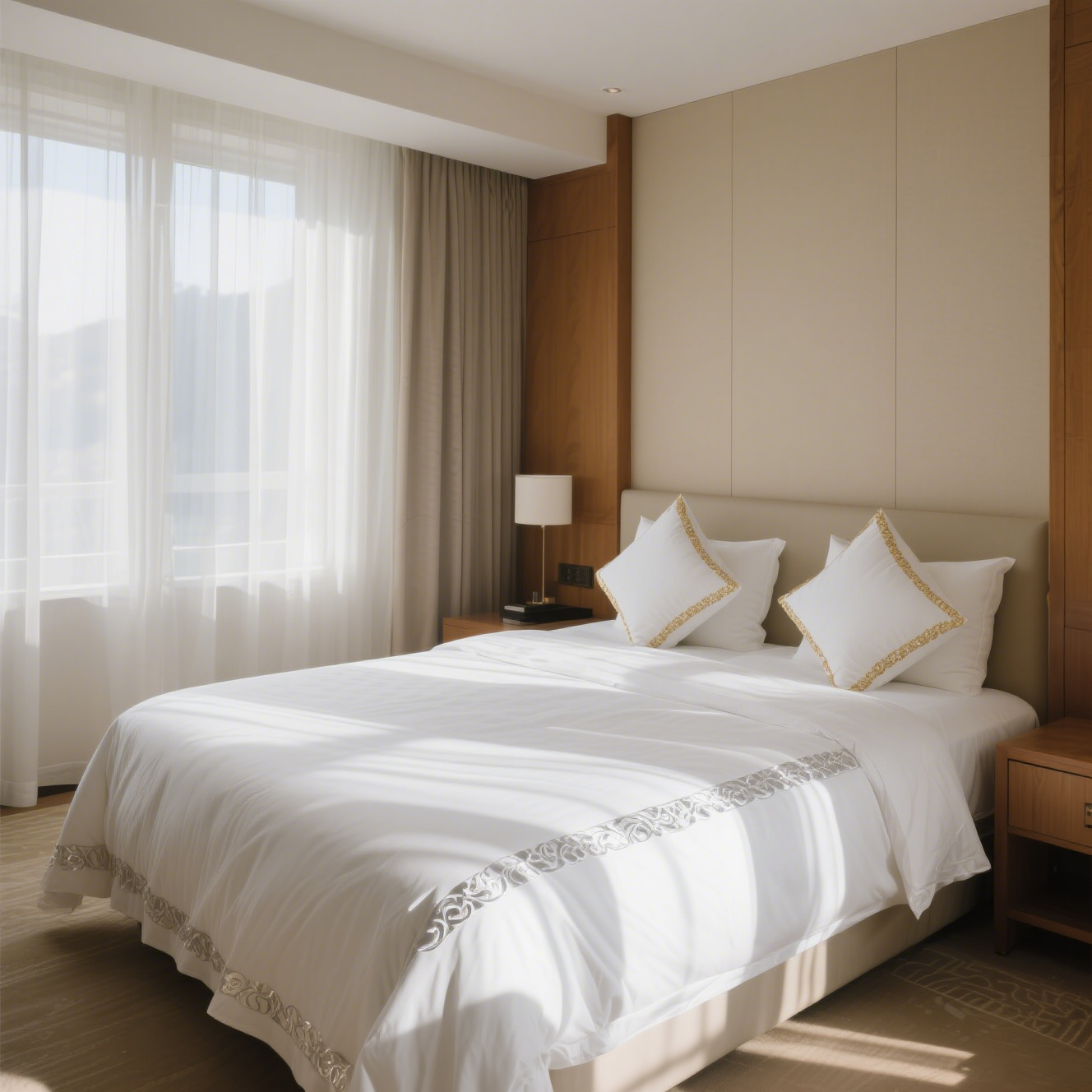
2. Gongdian Craft: The "Chip-Level Innovation" in Chinese Textile Industry
Structural precision: Five sets of three-ply satin weaving techniques ensure that the coverage rate of the warp yarns reaches 80%, giving the fabric a silk-like luster; the weft yarn density is 450 threads per inch (far exceeding the 200 threads of twill fabric), and the wrinkle resistance has been enhanced by 40%.
Operational efficiency conversion: The actual measurement at the InterContinental Hotel in Shenzhen shows that the Guandian bedding products reduce the daily linen sorting time for each room by 8 minutes, resulting in an annual savings of 120,000 yuan in labor costs.
Table: Performance Comparison of Cotton and Synthetic Fiber Bedding
Indicator:
Pure cotton bedding: (Wetness and breathability) 35% moisture absorption rate (Industrial washing durability) 300+ times (Biodegradation rate) 100%
Polyester blend: (Wicking and Breathability) 15%-20% (Industrial washing durability) 150-200 times (Biodegradation rate) Releases microplastics
Advantage range: (Wicking and Breathability) + 75% (Industrial Washing Lifespan) Release microplastics (Biodegradation Rate) Environmental-friendly crushing

3. Hanbi's "Technology + Service" dual engine model
Research and development patent barriers: Allocate more than 3.5% of annual sales revenue to research and development, developing innovative products such as nano-silver thread smart bed sheets (real-time heart rate monitoring) and phase-change microcapsule temperature-regulating quilt cores (self-adjusting to 28℃).
Full-cycle service chain: From demand diagnosis → sample production customization → logistics distribution → after-sales training, covering all scenarios from hotel opening to operational upgrade. The customer retention rate is 73% (industry average 52%).
4. Future Trends: The Next Step for Intelligent Cotton Textiles
Technology integration scenario: The Sealy iComfort mattress is equipped with over 3,000 sensors, which automatically adjust the headrest angle to prevent snoring and improve the customer's sleep quality score by 22%.
Hanbi's digitalization strategy: The ERP system enables full-process monitoring of the production process. The number of workers per 100 looms has decreased to 89 (the industry average is 100), and the per capita output has exceeded 1.2 million yuan per year.
When the wind from the cotton fields of Xinjiang passes through the intelligent looms in Jiangsu, and finally settles at the bedside of a hotel in Paris - this is the sleep poem written by China's supply chain.
